What is the state of cyber security in the media?
By Petra Schwegler, MedienNetzwerk Bayern
When the screen goes black, it is not just the editorial deadline or broadcast operations that are at stake, but the credibility of entire media brands. Various incidents in recent years have made it clear why the security of IT systems has become the new priority for programme management and Media and Cybersecurity is becoming a must. A trend that the Media Network Bavaria in the case of a Event has highlighted.
Let’s imagine the morning shift at the broadcaster is just getting underway, the first cup of coffee is still half full – and suddenly all the screens go black. The team has no access to playout software, editorial systems or emails.
What once sounded like a Hollywood plot is now a very realistic scenario for digitised and fully networked media organisations. Cyberattacks have long since ceased to target only commercial enterprises. Media organisations and their studios, newsrooms and production chains are now regarded as “Gateways for hackers“.
A fairly recent example that has shaken up the industry is the comprehensive cyberattack on Radio Arabella and Arabella Bayern in Munich. Within a very short space of time in November 2025, studio computers and monitors were affected, and live broadcasting was hanging in the balance. The fact that the station was still able to remain on air was not down to luck, but to preparation: a cloud studio, alternative signal feeds and clear emergency procedures were all in place. The recommended cyber resilience was already standard practice here.
Unfortunately, others had to be the ‘pioneers’: in January 2024, the local radio station Donau 3 FM in Ulm was taken offline by hackers. The Cybercriminals’ attack The radio station was initially able to keep going in emergency mode by switching to familiar analogue broadcasting technology and archived music CDs.
When hackers take out the media
On the other hand, there are cases where, in in which an attack caused entire houses to topple over. At publications such as the *Heilbronner Stimme* or the *Hamburger Abendblatt* Hackers paralysed editorial systems, meaning that newspapers were temporarily unable to publish, or could only produce emergency editions – a direct interference with their ability to operate as a media organisation. It subsequently took days or weeks for their IT infrastructure to recover, as was the case with the Hamburg-based newspaper shortly before Christmas 2020. Following the cyberattack, which was traced back to Russia and in which a ransom had even been demanded, As a result, the Abendblatt had to replace thousands of computers.
Not only money, but also trust in the brand was lost as a result. Suddenly, questions arise that go far beyond IT: How can media organisations fulfil their promise to their audience? How can they protect their credibility when systems can be manipulated or content blocked?
Here, the focus is shifting: for the media, cyber security is no longer purely a technical issue, but rather a strategic vote of confidence. When content is manipulated, data is intercepted or workflows are sabotaged, this strikes at the very heart of the journalistic ethos. In an environment where disinformation, deepfakes and AI-generated fakes are becoming the norm, no organisation can afford to be complacent about its own security. Any organisation that fails to protect its infrastructure risks, in the event of doubt, opening the door to doubts about its own integrity.
A far-reaching threat to the economy and the media
External pressure is mounting. According to industry surveys, over 90 per cent of companies see a the growing cyber threat, Ransomware remains one of the key threats. The Federal Office for Information Security has been referring to a "a tense to critical situation“IT security in Germany, driven by the fact that more and more systems are being digitised and connected. For media companies, this means that every cloud interface or additional remote studio is not only a source of efficiency gains, but also a potential vulnerability.”
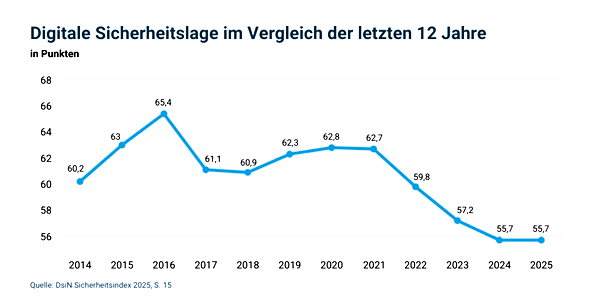
The data, as presented by MedienNetzwerk Bayern (source: DsiN Security Index)
Cybersecure Media It therefore involves more than just firewalls and antivirus software. It is about an architecture in which security is built in from the outset: from studio design and the choice of cloud providers right through to editorial processes and rights management. This includes regular backups, segmented networks and clear contingency plans – but above all, trained staff who can recognise phishing emails, manage passwords effectively and know what to do in an emergency.
Studies show that whilst many homes do invest in technology, but training and cultural change often lag behind. With AI, for example, it will become even easier to, Flooding companies with phishing emails. Added to this is a close look at IT service providers; hackers, for example, had used third parties to plant a Trojan in the news agency’s network dpa infiltrated.
It’s better to talk about it openly ...
The second key element is transparency. Anyone who remains silent in the event of an attack quickly loses control over the narrative – and, with it, trust. Media brands that deal openly with disruptions, analyse attacks and explain how they will better protect themselves in future actually strengthen their credibility.
This is how cyber resilience becomes an opportunity for communication. The motto: “We are vulnerable, but we are prepared – and we learn from every incident.” The Arabella Munich team led by the station director Till Coenen that is how he handled it.
At the event Media Trends 2026 From the MedienNetzwerk Bayern it became clear that security is now regarded as a key lever for implementing important trends.
As Overarching trends The following have been identified as media trends for 2026:

Petra Schwegler works in communications and marketing for Medientage München. Prior to this, the qualified journalist was in charge of the news desk at the trade journal W&V. Photo: Media.Bavaria GmbH, Alexander von Spreti
The Media Network Bavaria, is an initiative for Bavaria as a media hub. Through its events and projects, it brings together the Bavarian media sector to address the trends and challenges of digital transformation. It fosters networking both within the individual media sectors (such as audio, film or the press) and across sectoral boundaries (for example, with the automotive industry, the medical sector or the scientific community). MedienNetzwerk Bayern is part of the Media.Bavaria GmbH.