7 ideas to help your organisation prepare for agile transformation
Lessons learnt from Berlin Consulting
Photo / Video: Freepik, AI-generated
Agile transformation presents a challenge to organisations, employees and managers by introducing a new understanding of collaboration and organisation – particularly when the organisational design is not aligned with agile working practices. A holistic view of the organisation and the right management tools will help you navigate the agile transformation. We present seven inspiring ideas on how you can prepare your organisation for agile transformation.
An agile organisation presents you with a whole new set of challenges
When agile transformation is implemented and put into practice, it does not merely give rise to new working methods, processes and coordination formats within organisations. Traditional organisational structures – often characterised by hierarchy and functional divisions – are also being evolved into agile organisational forms: Cross-functional teams with flat hierarchies, which network with one another and are formed with varying compositions depending on the task and objective, are increasingly shaping the organisation. The shift towards an agile organisation presents new challenges for employees, managers and HR departments:
How are Career paths and Careers How should organisations be structured if staff take on and switch between roles flexibly, rather than holding a post for the long term?
Which Prospects for development What can managers offer their staff when long-term, rigid departmental planning is replaced by an agile, iterative approach?
Who gives to whom? Feedback, if networks and cross-functional units come to predominate in future, rather than a clearly defined line organisation?
How can personal goals How can we determine this when the intended project and work outcomes are constantly evolving through iteration?
How can tailored services be rewarded when the focus is on successful collaboration within cross-functional teams and networks?
How does one arrive at a suitable and accepted Salary model, when staff in their cross-functional team are faced with a wide variety of roles and responsibilities?
These uncertainties inevitably arise when an organisation comes to a standstill after developing and introducing new structures, roles and processes. Whilst designing an appropriate organisational structure and workflow, as well as suitable working methods, is of great importance to an organisation’s performance – a holistic organisational design involves more than that:
Governance mechanisms, decision-making powers and methods, in order to facilitate effective leadership
Consultation processes, communication flows and procedures, in order to ensure overall coordination
Management tools, objectives, incentive and feedback systems, in order to set out expectations regarding the behaviour of those involved in the organisation and to manage them effectively
Staff development systems to enhance skills and motivation to ensure staff involvement and an appropriate degree of planning certainty
Rules and guidelines, in order to maintain functionality and meet standards
Design of physical and digital spaces, in order to support collaboration as effectively as possible
This is how an agile organisation meets these challenges
The aim is to develop a comprehensive organisational design in which the organisational structure and processes, methods, management tools and staff development systems are well-coordinated and interlinked. This makes it possible to develop solutions – some of which are simple and straightforward – to the challenges mentioned, which support the success of the agile organisation:
Career stages
The emphasis on seniority or length of service, which is reflected in the distinction between junior and senior roles, is of secondary importance in agile organisations.
Example: Thanks to her excellent training and high level of motivation, the young graduate may well generate greater added value than her more experienced colleague, whose willingness to adapt is limited.
Solution: Focus on making your employees’ skills, motivation and willingness to take responsibility – all of which are key to achieving results – transparent and on fostering them. You should therefore place greater emphasis on clear roles and their descriptions (What is someone responsible for?) rather than on individual job titles.Development paths
In agile organisations, the significance of the traditional career ladder is also changing. The variety and flexibility of possible career paths are increasing.
Example: In a traditional organisation, opportunities for career progression are severely limited for a highly skilled employee who has no interest in taking on leadership responsibilities. It is simply expected that career development goes hand in hand with taking on a leadership role.
Solution: Allow for development in different directions. This enables your staff to pursue a specialist career path and become ever more skilled experts. A management career, on the other hand, allows them to develop and utilise their organisational and leadership skills. A leadership career, on the other hand, turns your staff into excellent leaders who support their colleagues in delivering their best performance. A combination of different pathways is also possible, but not all components are necessarily part of the career ladder.Salary model
When people in very different roles work together in cross-functional teams and take on various responsibilities, it becomes more challenging to compare staff remuneration and arrive at a fair overall pay structure.
Example: The young social media manager works closely with the successful and well-paid sales manager, who doesn’t arrive at the office until midday, having just finished a client meeting in her prestigious company car.
Solution: Instead of comparing apples with pears, look across teams for more apples. Company-wide job families, in which similar roles are considered together, can help you and your staff make meaningful comparisons and develop a transparent pay model. This also enables you to create motivating career paths for your staff.Objectives and Bonuses
The dismantling of fixed functional units in favour of agile teams means that individual goals take a back seat to overarching team or organisational success.
Example: In functional teams, ‘interim targets’ are inevitably set, which represent just one step on the path to the desired success. Marketing, for example, is responsible for raising awareness of a product, whilst sales is responsible for selling the product. A cross-functional and sufficiently capable team, on the other hand, can also be set outcome-based targets, such as increasing the contribution margin or the customer lifetime value.
Solution: Use team-based targets and bonuses to emphasise that the team’s success – and thus collaboration – is more important than individual performance, which may not be coordinated or compatible with one another and has no impact on the company’s success.Policy instruments
Flat hierarchies and a high degree of autonomy within teams call into question the traditional management tasks of ‘planning’ and ‘control’.
Example: A well-coordinated team of developers is therefore much better placed to assess the effort required and what results are realistically achievable within the given timeframe than a single project manager or line manager. The manager’s attempt to adjust the planning during an ongoing sprint may work in the short term, but in the long term it leads to poorer outcomes.
Solution: Ensure that decisions are based on competence, not hierarchy. Place operational control in the hands of the teams (e.g. through agile ‘pull’ methods such as Kanban). Focus even more strongly on fostering collaboration within the organisation, promoting productivity and efficiency (e.g. through systematic impediment management – that is, identifying and removing obstacles for your teams) and effectively communicating strategic goals and guidelines. For whilst the role of leaders and management is not obsolete in agile organisations, it does require fundamental development.Feedback
Flexible roles and changing team compositions make it difficult for managers to provide well-founded and constructive feedback.
Example: An employee who is part of a cross-functional team working on a project collaborates much more closely with colleagues from other functions than with her line manager.
Solution: Take other perspectives into account and seek feedback from the team, colleagues in the same job family, and internal and external customers. This will help you improve the effectiveness and quality of the feedback in the long term.Guided tour
With new structures and forms of collaboration, the role of leadership is also undergoing a shift in meaning. Teams no longer expect a leader who actively takes the reins and has an answer to every question.
Example: The manager of a marketing team can support team members by drawing on their own expertise. However, when experts from different fields work together in cross-functional teams, the manager reaches the limits of their own specialist knowledge and cannot cover all areas of expertise.
Solution: Separate the management and leadership of your teams. This allows self-organised teams to manage themselves. The experts within the team can, for example, be led by a manager from the relevant job family in terms of technical matters.
Often, the tools and instruments are already familiar and in place; they simply need to be fine-tuned or realigned. In other cases, an agile organisation requires a new way of thinking. That sounds more difficult than it is. Often, the key lies in consistently applying agile principles such as communication, simplicity and self-organisation, as well as in overcoming the traditional mindset that management and leadership must come from a single source.
How to develop suitable solutions for your organisation
A holistic view of organisational design and alignment with the principles underpinning agile organisations are best achieved through a systematic and methodologically sound approach. With Orgazign, a method developed by Berlin Consulting, you can develop your new organisational design step by step, whilst incorporating its key aspects.
Using three canvases as a basis, participatory workshops involving cross-functional and cross-hierarchical teams are held to develop optimal solutions for your organisation:
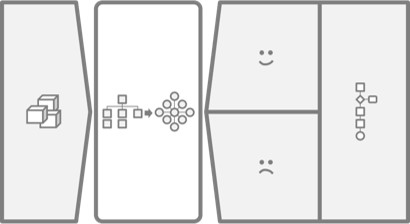
1. The Organisational Challenges Canvas is designed to identify organisational challenges:
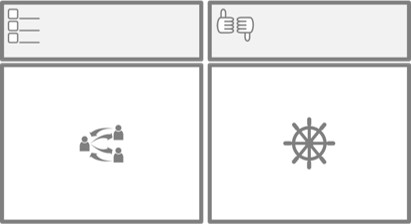
2. With the Organisation Model Canvas Develop the basic structure of the new organisational model, i.e. areas of responsibility and units:
3. The Organisational Design Canvas enriches the organisational model with the appropriate management tools, working methods, rules and coordination procedures:
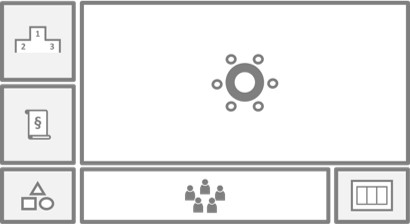
If you have already taken the first steps towards a new, more agile organisational structure and have either designed or already implemented a new organisational structure, the Organisational Design Canvas will help you to develop a fully coordinated organisational design. To do this, you develop the existing building blocks – such as tools (e.g. control mechanisms, target, incentive and feedback systems), rules, guidelines and working methods – and evaluate them systematically:
Which elements of the organisational design can be retained?
Which components need to be adapted and further developed?
Which building blocks need to be removed?
Should new building blocks be developed and implemented in future?
Does this result in an organisational design that is, on the whole, effective and coherent?
To this end, Orgazign provides an easy-to-use framework of requirements and quality criteria for all components, as well as guiding questions and assessment schemes. This may also give rise to important requirements regarding processes and organisational structure: Which roles bear which responsibilities for implementing the tools, rules and methods? What processes are required for this? Do new requirements arise for cross-functional coordination, for example in committees and meetings? By incorporating these new requirements into your existing organisational model – in a fully agile and iterative manner – you will optimise your agile organisation and ultimately achieve a consistent and future-proof organisational design.

Berlin Consulting guides media companies through the digital transformation. The consultancy develops strategic solutions, brings fresh perspectives to the table and supports its clients in their digital transformation with practical approaches. With its innovative methods – Orgazign, Technology Fit and Agile Process Optimisation – the company has created tools that reduce complexity in change processes whilst taking organisational, technological and human aspects into account in equal measure.
The service portfolio ranges from the development of digital business models and the design of future-proof organisational structures to agile process optimisation. Berlin Consulting also handles project management for the selection and implementation of IT systems.
The Orgazign method is also available as a book: Organisational Design – Creating Organisations Worth Living In, 3rd edition 2025, Vahlen