Productivity is no accident
An extract from the book *The Efficiency Principle* by Christian Zielke
‘The Efficiency Principle’ (Haufe) by Christian Zielke sets out practical strategies and methods for acting more effectively in both professional and private life – not by doing more work, but by working more intelligently. At the heart of this approach is the distinction between effectiveness (doing the right things) and efficiency (doing things right).

Published: 2 April 2026 | Photo / Video: AI-generated, Freepik
In this chapter 1.3, the author presents nine basic principles of effectiveness, which serve as the foundation for efficient action. Each principle is clearly illustrated with an everyday metaphor and supplemented by specific reflection questions – as an invitation to critically examine one’s own working methods and to develop them in a targeted manner.
The Nine Principles of Effectiveness – Your foundation for efficient action
Effectiveness and efficiency go hand in hand, but they serve different purposes: effectiveness means doing the right things – in other words, focusing your energy specifically on the tasks that really matter. Efficiency means doing things right – that is, completing these tasks with minimal effort. Effectiveness lays the foundations, whilst efficiency optimises the process.
The nine principles of effectiveness will help you to lay precisely this foundation.
Principle No. 1: Clarity – knowing what matters
Clarity means keeping track of things and making informed decisions. It’s about recognising which tasks and goals are truly important – and not getting lost in the flood of urgent matters. Only those who know what really matters can focus their energy effectively and, as a result, be more successful and satisfied in the long term.
Imagine you were a gardener. If you watered all the plants at once, without considering which ones actually need water at that moment, your garden would never really thrive. Clarity means identifying the plants that need the most care right now – and focusing your energy precisely on them.
• Which tasks in your day-to-day life distract you rather than helping you make progress?
• When was the last time you deliberately said ‘no’ so that you could focus on what really matters?
• What could you gain by consistently focusing on what really matters?
Clarity helps you identify your priorities and focus on what really matters. However, even with clear goals, another problem can arise: everyday life is often characterised by unnecessary complexity. Overburdened processes, inefficient workflows and complicated systems make it difficult to achieve goals effectively. This is precisely where the next principle comes into play.
Principle No. 2: Simplicity – Less is more
Simplicity means reducing complexity and focusing on the essentials. It is about streamlining processes, simplifying routines and making decisions more quickly. Making everyday life simpler is not only more efficient, but also less stressful.
Imagine a crammed wardrobe. The more clothes pile up inside it, the harder it is to find the perfect outfit. Simplicity means choosing the clothes you really need and letting go of everything else. A tidy wardrobe saves time and stress – just like a simplified everyday life.
• Which tasks or processes in your day-to-day life are unnecessarily complicated?
• What could you simplify to make progress more quickly and effectively?
• Which routines are holding you back rather than helping you, and how could you change them?
Simplicity can help streamline everyday life and eliminate unnecessary complexity. Yet even with clear priorities and streamlined processes, you may still find yourself getting bogged down time and again. The reason: you’re trying to tackle too many tasks at once. This is where the next principle comes in.
Principle No. 3: Prioritisation – The power of the right order
Prioritisation means organising tasks according to their importance and urgency and tackling them in a targeted manner. It is not about trying to do everything at once, but about proceeding step by step. This creates focus, which is crucial for long-term success.
Imagine a plate piled high at a buffet. If you try to taste everything at once, you’ll lose the pleasure of it and waste your energy. Prioritising means consciously choosing which dishes are truly worthwhile for you – and savouring them at your leisure.
• Which tasks on your list are truly crucial to your success?
• Which activities simply fill up your day without adding any real value?
• What would happen if you consistently worked according to your priorities and let go of everything else?
The principle of prioritisation brings structure and focus to your decision-making. It is the key not only to working efficiently, but also to achieving lasting success. Yet many tasks are often repetitive and take up valuable time. The crucial question is: is there a way to complete these tasks more easily and quickly? This is precisely where the next principle comes in: automation – efficiency through technology.
Principle No. 4: Automation – Efficiency through technology
Automation means designing repetitive processes in such a way that they run with minimal effort – either through technology or through intelligent workflows. The aim is to carry out routine tasks that take up time and energy efficiently, so that there is more time for strategic tasks.
Think of an automatic sprinkler system in a garden. Instead of laboriously going from plant to plant every day, the system ensures that every plant gets the right amount of water at the right time. Automation means organising your daily life so that it ‘runs’ itself, whilst you take care of the things that really matter.
• Which recurring tasks take up your valuable time every day and could be automated?
• Which tools or technologies could make your day-to-day work easier?
• What could you gain if you spent less time on routine tasks and more time on strategic ones?
Automation is the principle that takes routine tasks off your hands, giving you the freedom to focus on what really matters. With the right systems and tools, you’ll not only save time but also enjoy a better quality of life.
Principle No. 5: Delegation – Delegating tasks effectively
Delegation means handing over tasks to others who can carry them out just as well, or even better. It is about sharing responsibility, building trust and focusing on one’s own core tasks. Delegation is not only a way of lightening the load, but also an opportunity to support others and strengthen the team.
Imagine a team taking part in a relay race. If one runner tries to run every leg themselves, the team will never win. Delegation means passing the baton at the right time and trusting that everyone in the team will play their part in the team’s success.
• What tasks do you carry out on a regular basis that someone else could do just as well, or even better?
• How could you make better use of your colleagues’ or your team’s potential?
• What could you achieve if you focused your time and energy on your core tasks?
Delegation is the key to avoiding burnout and making the most of the potential of those around you. With clear agreements and trust, you not only create greater efficiency but also build a stronger team.
Principle No. 6: Concentration – Monotasking rather than multitasking
Concentration means focusing entirely on a single task, rather than doing several things at once. It’s about minimising distractions, setting priorities and working on one thing with your full attention. Concentration not only leads to better results, but also saves time and energy.
Imagine you are filling several glasses with water from a jug at the same time. In the end, none of the glasses is really full, and the jug is empty. Concentration means filling one glass at a time – efficiently, purposefully and without waste.
• What distractions prevent you from carrying out your tasks with full concentration?
• How could you organise your working day so that you can focus on one thing at a time?
• What would you gain if you made a conscious decision to focus on one task at a time every day?
By applying the principle of concentration, you can make your day-to-day life significantly more productive and minimise distractions. However, even when you are fully focused on individual tasks, the constant strain can take its toll. Anyone who works under constant pressure without ensuring they get enough rest risks burnout. This is where the next principle comes in:
Principle No. 7: Balance – Efficiency without burning out
Balance means consciously setting aside time for rest, breaks and personal needs. It is not just about working efficiently, but also about living mindfully. After all, true efficiency arises when there is a healthy balance between working time and recovery time.
Imagine a bow that remains constantly drawn. Over time, the bowstring loses its elasticity; the bow becomes unusable and can no longer unleash its full power. The same applies to us: without regular breaks and rest, our performance and resilience decline. Only when the bowstring is released can it build up new tension – and only those who make a conscious effort to regenerate remain efficient and high-performing in the long term.
• Do you regularly set aside time for breaks and personal relaxation?
• Where could you set boundaries to protect your energy?
• Which activities give you new energy and bring you joy – and how often do you find time for them?
The principle of balance is the key to combining efficiency with a zest for life. It shows that it is not just about how much we achieve, but also about how we feel whilst doing so. Efficiency without balance leads to burnout – with balance, it becomes the foundation of a fulfilling life.
Principle No. 8: Reflection – Learning and adapting
Reflection means consciously taking the time to scrutinise one’s own working methods, decisions and results. It is about learning from experience, measuring progress and, where necessary, developing new approaches. Reflection is the driving force that enables us to improve continuously.
Imagine going on a hike in the mountains without ever stopping to check your map. Reflection is like looking at a map: it helps you check your route, spot any obstacles and ensure you stay on the right path.
• When was the last time you consciously thought about what went well or badly during your week?
• Which of your current habits contribute to your success – and which ones are holding you back?
• How could you adapt the way you work to be even more efficient and satisfied?
The principle of reflection is essential for sustainable efficiency. It shows that success depends not only on taking action, but also on the ability to pause, learn and adapt. Through reflection, efficiency becomes a continuous process of growth.
Principle No. 9: Sustainability – Efficiency with a purpose
Sustainability means using resources consciously and wisely – not only in an environmental context, but also in our personal and professional lives. It is about thinking and acting with the long term in mind, in order to combine efficiency with a deeper purpose. Sustainable efficiency leads to results that stand the test of time, whilst respecting our energy, time and values.
Imagine a well from which you draw water every day. As long as it is fed by a deep spring, it will remain a reliable source. But if no one protects and looks after the spring, the well will eventually run dry. Sustainability means not just drawing water for the short term, but also ensuring that the source is preserved – whether in our work, our resources or our energy.
• Which of my current tasks really contribute to long-term success – and which only bring short-term benefits?
• How do you allocate your time and energy in a way that is consistent with your values and goals?
• What changes could you make to ensure your efficiency is more meaningful and sustainable in the long term?
The principle of sustainability reminds us that true efficiency is based not only on figures and results, but on meaning and sustainability. It is the way to combine efficiency with fulfilment and a mindful way of life.
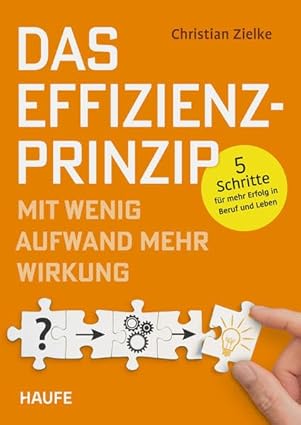
From: Christian Zielke: The Efficiency Principle. Greater impact with less effort. 196 pages, paperback. ISBN: 978-3-648-19030-2. (D) €29.99