The end of departmental silos
How AI is transforming the publishing industry from the ground up. Findings from Roland Berger’s study on the ‘AI-First Organisation’
Published: 9 July 2026 | Photo / Video: AI-generated, Magnific
The technology works – yet 95 per cent of generative AI pilot projects in companies fail due to a different problem: the operating model. A global study by Roland Berger shows (Download here),
which structural forces are already at work and which nine specific shifts set successful organisations apart – as analysed and interpreted by us for the media and publishing industry.
Boards approve AI roadmaps. IT departments procure tools. Pilot projects are launched with genuine commitment. However, according to the MIT report ‘The GenAI Divide: State of AI in Business 2025’, 95 per cent of generative AI pilot projects in companies deliver no measurable financial impact. The problem is rarely the technology – it is almost always the operating model that remains unchanged.
A global survey of 472 executives conducted by Roland Berger reveals a striking gap between ambition and execution: 62 per cent expect AI transformation to bring about major or radical changes to their operating model. Yet only 38 per cent have already begun to take action. Even more alarming: 59 per cent consider their organisation’s leadership to be inadequately prepared.
Why this issue is relevant now
The publishing world is on the cusp of a structural turning point. AI tools are available, affordable and powerful. Yet whilst digital-native companies are designing their processes from the ground up around AI, established media organisations are often still trying to integrate AI into existing, traditional structures. The result: isolated use cases, fragmented data landscapes and pilot projects that never scale.
Roland Berger’s study shows that the real obstacle to AI-driven value creation is not technological requirements (34 per cent), but people, skills and capabilities (49 per cent), followed by organisational structure and processes (37 per cent) and leadership and culture (30 per cent). It is the human and organisational dimensions where the real work needs to be done, particularly within publishing houses.
Almost half of the senior leaders surveyed (49 per cent) identify people, skills and capabilities as the biggest barrier to creating value through AI. Organisational structure and processes follow at 37 per cent, whilst technological requirements account for 34 per cent.
This ranking runs counter to current practice: boards are investing huge sums in AI platforms and licences, whilst governance frameworks, decision-making architectures and leadership models remain largely unchanged. The result: AI power without AI performance.
Four forces that are already reshaping organisations
Roland Berger identifies four structural forces that are already at work:
1. The widening productivity gap Early evidence from organisations using agent-based AI on a large scale points to productivity gains measured not in percentage points but in multiples. The gap between innovative frontrunners and laggards in the publishing industry could widen exponentially.
2. The end of functional silos In an outcome-led operating model, the starting point is not the process, but the outcome. An agent-based system works backwards and autonomously identifies the precise inputs required to achieve the outcome. Dr Cyrus Asgarian, Senior Partner at Roland Berger: “The starting point in an AI-first operating model is not the process, it’s the result. This shift means that functional silos no longer have a raison d’être.”
3. The accountability challenge for AI-first leadership In the AI-First Operating Model, AI orchestrates end-to-end execution, whilst people define objectives and success criteria within clear boundaries. Decisions – rather than purely operational tasks – become the primary focus. Outcome-driven governance replaces role-based control.
4. The squeeze on domain specialists Organisations face a strategic choice: which activities require genuine, world-class human expertise, and which can be handled by AI-augmented generalists? The answer takes the form of an ‘Hourglass Capability Architecture’: at the top sits a small group of very deep subject matter experts; the middle narrows dramatically; and at the base, a new tier of broad generalists emerges, augmented by AI tools.
Nine specific shifts in the operating model
Roland Berger organises the necessary changes into nine phases across three levels: Foundation, Execution and Scaling.
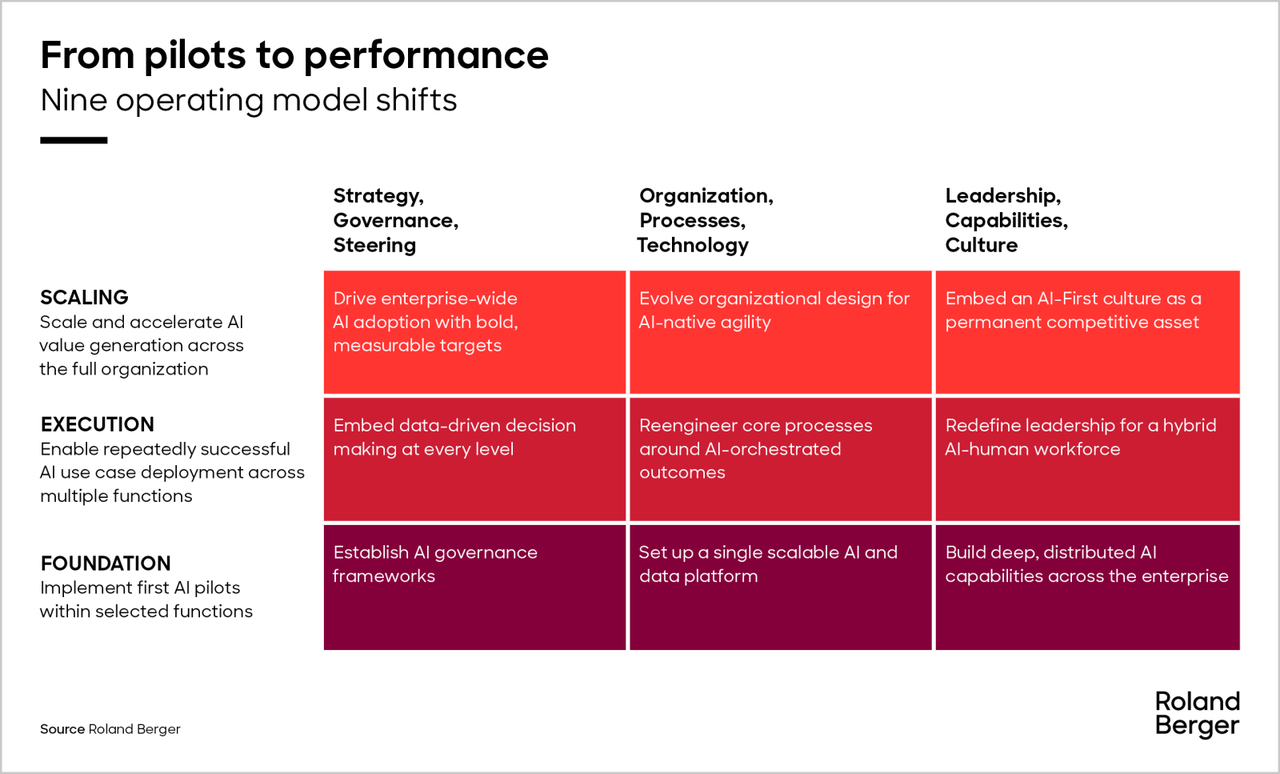
Foundation Shifts:
Shift 1: Establish AI governance frameworks
42 per cent of organisations are not confident that they have the right AI governance framework. Governance is not bureaucracy, but a trust infrastructure that enables scaling.Shift 2: Setting up a scalable AI and data platform
65 per cent of AI leaders operate on shared technology platforms, compared with just 18 per cent of laggards – a factor of 3.7. However, 59 per cent report that their data governance is inadequate.Shift 3: Building in-depth, distributed AI capabilities
58 per cent of AI frontrunners are building AI capabilities across all business groups, compared with just 14 per cent of the laggards. Companies with distributed AI capabilities are 2.3 times more likely to report having an ‘AI-first’ mindset.
Execution shifts:
Shift 4: Embedding data-driven decision-making
88 per cent of AI frontrunners practise systematic, data-driven decision-making, compared with 43 per cent of laggards. 69 per cent of frontrunners systematically delegate decision-making authority down the hierarchy.Shift 5: Re-engineering core processes centred on AI-orchestrated outcomes
73 per cent of AI frontrunners operate in cross-functional, agile teams, compared with just 18 per cent of laggards – one of the biggest differences in the entire survey (a factor of 4).Shift 6: Redefining leadership for a hybrid AI-human workforce
Only 15 per cent of respondents report that their organisation has broadly repositioned the leadership role. Even amongst AI frontrunners, the figure stands at just 38 per cent.
Scaling shifts:
Shift 7: Driving company-wide AI adoption with measurable targets Only 15 per cent of organisations report having clear KPIs for AI adoption. Without defined targets, scaling efforts lose their way: investment flows into visible activity rather than measurable impact.
Shift 8: Further developing organisational design for AI-native agility
AI frontrunners operate with flatter structures and report lower organisational complexity – in both cases, 29 per cent more frequently than laggards.Shift 9: Embedding an AI-first culture
In organisations where leaders are regarded as genuine role models for AI transformation, 69 per cent report having a strong ‘AI-first’ mindset. Where leaders are not seen as role models, this figure drops to 18 per cent – a fourfold difference.
Nine specific shifts in the operating model
The nine operating model shifts provide a concrete framework for action: Laying the foundations (governance, platform, distributed capabilities), enabling execution (data-driven decisions, process re-engineering, redefining leadership) and embedding scaling (ambitious targets, AI-native organisational design, AI-first culture).
The strategic question for every senior leadership team in publishing is no longer whether AI will transform their operating model – that question has long since been answered. The question is whether the media company will lay the foundations now, or realise too late that simply rolling out tools without structural readiness will not deliver results. The technology is rarely the problem; it is almost always the operating model.