Digital doppelgängers
Gabriele Horcher explains why the CEO’s ‘co-brains’ can boost productivity. Advertorial
Published: 9 June 2026 | Photo / Video: AI-generated, Aiconiq
Zuckerberg (CEO of Meta) is doing it. Siemiatkowski (CEO of Klarna) is doing it. And Khosrowshahi (CEO of Uber) is doing it too. They are all using artificial intelligence to create digital doppelgängers of themselves. In future, employees and customers alike will be able to chat with the digital doppelgängers of Mark, Sebastian and Dara. These CEOs are thus providing a new, interactive channel of communication.
The German start-up Aiconiq.io goes one step further. Because when the knowledge of a CEO or an expert is transferred into a Co-Brain, it can not only serve as a chat partner, sparring partner or mentor – it can also be used as a knowledge base for agent-based AI systems. In this way, a company’s own AI agents can carry out context-sensitive tasks in the CEO’s style – consistently, scalably and entirely in line with their vision.
What can a CEO’s ‘co-brain’ do?
A Co-Brain is the digital, AI-based version of a real person within a company. The Co-Brain can answer questions, offer advice or provide insights to any authorised person – from senior managers to interns – in specific areas, in line with their role. However, unlike the CEO, the Co-Brain is infinitely scalable and can answer thousands of questions simultaneously. And it does so round the clock, from anywhere, in any language.
If necessary, the Co-Brain can also ask questions itself to find out more about the background. If the Co-Brain is trained using highly personal material from the CEO – such as speeches, blog posts, interviews or presentations – it can also adopt that person’s communication style and way of arguing. Questions or tasks may be entered in a variety of formats – that is, via text, speech or graphics.
Furthermore, AI agents can also carry out complex tasks using the Co-Brain’s knowledge base. Depending on a person’s authorisation or role, tasks such as carrying out analyses, planning measures or even drafting texts are performed. In doing so, the Co-Brain acts as the AI version of the person it digitally represents.
Types of Co-Brains
A HR Co-Brain is an AI-powered knowledge and decision-making model that draws on the working methods, thought processes, knowledge and experience of a single individual. It supports only that specific individual in decision-making, communication and prioritisation, and acts as a personal cognitive enhancer. Furthermore, only that person can submit agent-based requests to their own Co-Brain.
A General information Co-Brain is, by contrast, a collaborative AI system that serves as an intelligent point of contact for employees on matters relating to knowledge, processes and operational issues. The Co-Brain may – but need not – be based on a single individual in a leadership role within the organisation. Employees also have the option here of commissioning AI agents that access the knowledge stored in this Co-Brain.
A Corporate Brain is an organisation’s central, company-specific knowledge base, in which the processes, experiences, decision-making logic and specialist knowledge of all relevant staff members are brought together. The Corporate Brain extends the concept of the individual Co-Brain to the entire organisation. AI agents that access such a Corporate Brain can carry out complex tasks using the accumulated knowledge and in the best interests of the organisation.
How is a Co-Brain trained?
The Co-Brain is trained using existing content from a specific individual in the form of text, images, audio or video: internal or public appearances, books, specialist articles and blog posts. However, 80 per cent of a CEO’s knowledge is not usually contained in documents. Rather, it exists as implicit knowledge – or tacit knowledge – in communication with others and within the person’s mind. This is why that person’s communications – in the form of emails, chat messages, recorded telephone calls, transcribed meetings and conversations, etc. – are also very important. In order to integrate the CEO’s expert knowledge, experience and soft skills into the Co-Brain, AI-guided interviews are conducted with the CEO – scientifically grounded and dynamically generated.
In addition, specific external expert knowledge can also be integrated from the organisation’s curated knowledge resources, such as databases, studies or research.
Chat, voice or avatar?
Depending on how the Co-Brain has been trained, it can answer questions in writing – or the answers can also be read out in a neutral voice. If the Co-Brain is trained using genuine audio and video files of the CEO, it can even speak using that person’s cloned voice. It then becomes possible to make a virtual call to the Co-Brain Voice, ask questions verbally and receive spoken replies.
The avatar is the visual evolution of the Co-Brain. It depicts the person as a moving image or a photorealistic 3D character, complete with the real person’s gestures and facial expressions. Such a Co-Brain avatar can then also take video calls. This means that avatar communication actually takes place in real time – rather than as a pre-produced or pre-rendered clip.
High safety requirements
When a person possesses such a wealth of internal and personal knowledge, it must be ensured, firstly, that the Co-Brain can only be accessed via a strictly person- or role-based system. And, furthermore, that data sovereignty is always is guaranteed for the organisation.
Major US large language models (LLMs) such as ChatGPT, Claude and Gemini also offer businesses the opportunity to personalise knowledge to a certain extent – for example, as Custom GPT – and then access it via AI agents. However, using these AI agents means relinquishing claims to data sovereignty, security and confidentiality. This is because using the AI agents of a US LLM means operating within a public cloud under US control – with all the associated risks to the security of one’s own data. It is no coincidence that, with its EU Cloud Sovereignty Framework last year, the European Commission provided a clear response to the legitimate security concerns arising from the US Cloud Act and ‘Trump 2.0’. Furthermore, international solutions for agentic AI almost never meet the requirements of the General Data Protection Regulation (GDPR) – yet companies in Germany and Europe are under a legal obligation to comply with this EU regulation.
At the Frankfurt-based start-up Aiconiq.io Companies always retain full data sovereignty, as the necessary AI models are hosted on German or European servers. If they wish, companies can even host their own individual AI knowledge base themselves, on-premises and with maximum control. Furthermore, all communication is end-to-end encrypted.
Role-based or user-based access rights are further security features. Whilst the communications department, for example, is granted access to the CEO’s Co-Brain so that it can draft speeches and press releases in his style, a specialist department can, for example, develop market strategies based on this knowledge base.
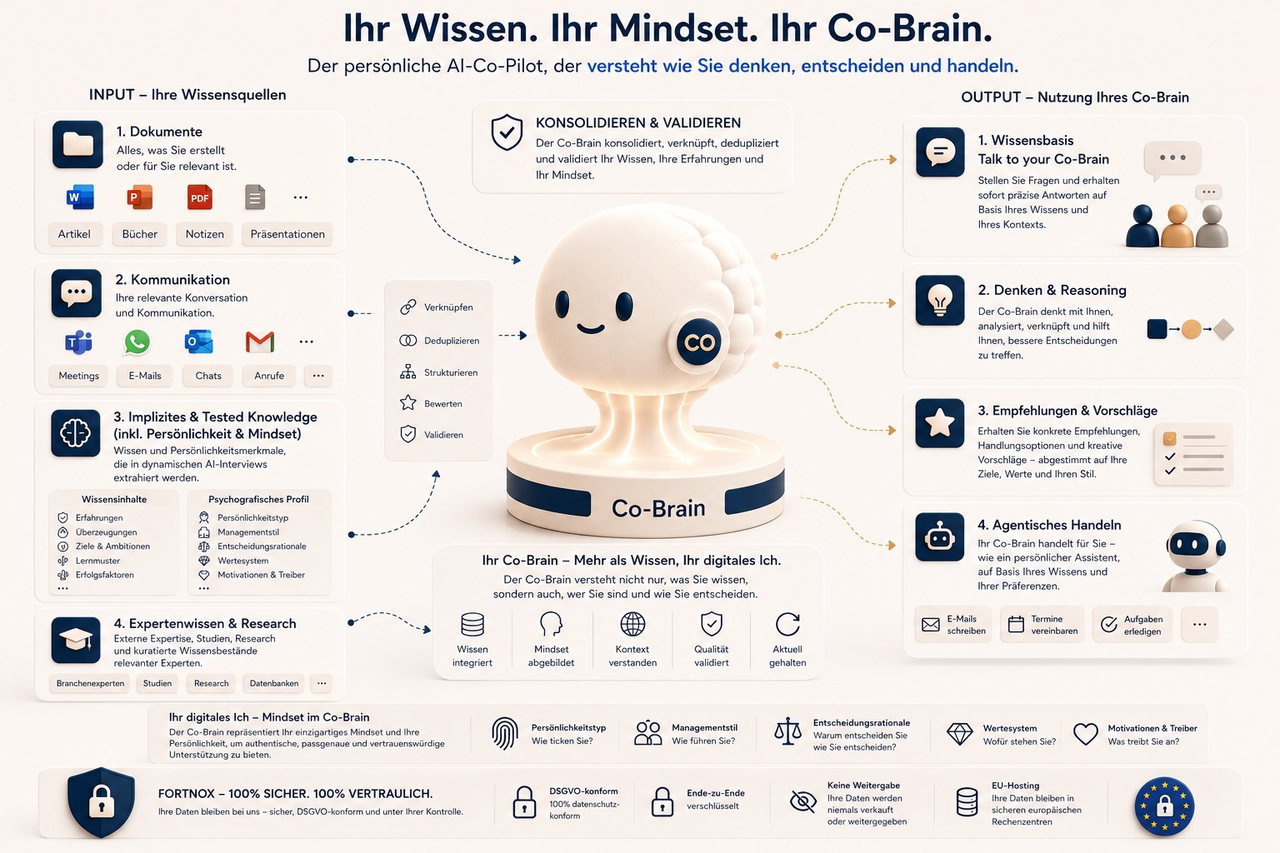
A Co-Brain can reduce the time spent preparing for strategic decisions by 30 to 60 per cent and save hundreds of hours of management time each year.
Conclusion: Not just a gimmick, but a boost to productivity thanks to Agentic AI
It is only through the use of agentic AI that a digital doppelgänger takes the crucial step from being an interactive toy to delivering genuine productivity gains. And AI agents only become truly effective and productive when they do not rely on the generalist knowledge of large language models, but instead draw on the vital individual know-how – including implicit knowledge – of a specific person or organisation. For it is only when the AI’s intelligence is fed by a manager’s ‘co-brain’ or an organisation’s ‘corporate brain’ that the AI can truly act in the best and most meaningful way for the company.
Gabriele Horcher in conversation with Peter Gentsch, CEO Aiconiq.io
"How should one envisage the Corporate Brain AI solution as the foundation of the enterprise AI infrastructure or of AI agents?"
Peter Gentsch: “Autonomous AI agents can only act effectively and deliver real benefits to the company if they have access to company-specific organisational, process and decision-making knowledge – rather than general knowledge. Our innovative approach to Agentic AI is therefore based on a company-specific ‘Corporate Brain’ as the control centre. This Corporate Brain is, as it were, the company’s AI brain. It keeps the company’s aggregated knowledge up to date, valid and secure, and enables the AI agents to work within the company with maximum productivity and effectiveness. A company’s own Corporate Brain becomes a game-changer – in future, it will control an organisation’s value creation.”
Is there a suitable intermediate step for organisations that would like to take the first step now – but perhaps do not wish to transfer all their organisational knowledge into a Corporate Brain straight away?
Peter Gentsch: It makes perfect sense to gather the company’s knowledge in small steps and to train the Corporate Brain gradually. It is important not to overload such a project. Furthermore, staff acceptance and participation are significantly higher when senior management is also involved. Nor does the use of AI always have to focus initially on areas such as ERP, sales or customer service. We are currently also implementing projects in which we first create digital versions of CEOs – that is to say, we transfer their knowledge, including their tacit knowledge, into a Co-Brain. However, with our technology, we can develop these into cognitive systems capable of operationalising executives’ decision-making logic and making it available on a scalable basis.”
Whilst your Corporate Brain AI solution ideally makes the knowledge of an entire organisation accessible, is the Co-Brain designed to tap into C-level knowledge?
Peter Gentsch: Yes, that’s one way of putting it. The principle is the same. Naturally, we train the Co-Brain – or Personal Co-Brain – using the individual’s valuable tacit knowledge; here, too, the integration of tacit knowledge with AI is indispensable. In this way, for example, we can create an Executive AI to act as a sparring partner for management, preparing, simulating and refining strategic decisions in real time. A pure data model becomes an active decision-making body, traditional reporting gives way to operational control, and an isolated tool evolves into an organisational thinking system.
Our Co-Brain can reduce the preparation time for strategic decisions by 30 to 60 per cent and save hundreds of hours of management time each year. Another key advantage lies in consistency: decision-making logic is standardised across teams and organisations. Such a Co-Brain gives rise to a new quality of leadership that, for the first time, is systemically scalable. AI no longer merely supports decision-making, but becomes an integral part of the decision-making structure itself.
By the way, you can find my own Co-Brain at https://hk.aiconiq.io/“
“Save hundreds of hours of management time each year”
Gabriele Horcher in conversation with Peter Gentsch, CEO Aiconiq.io
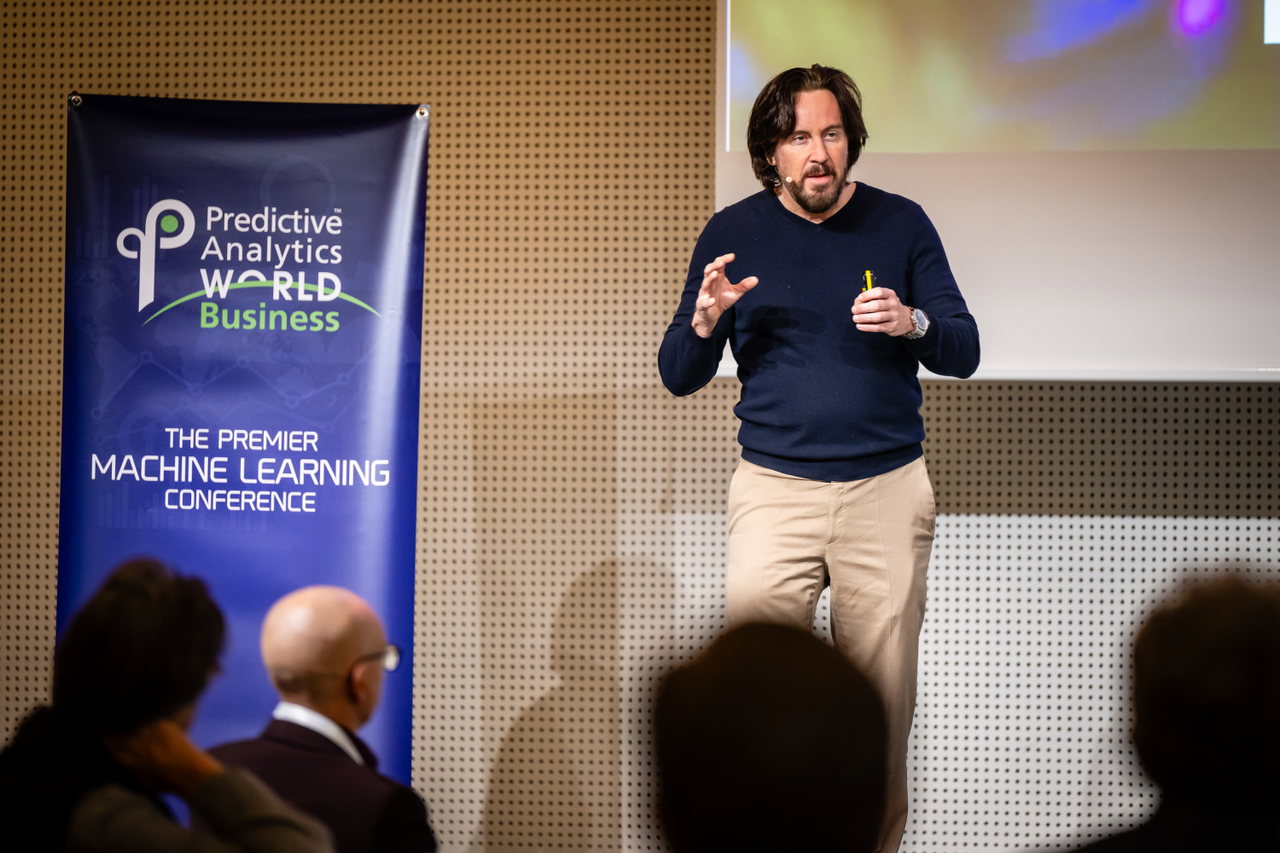
Prof. Dr Peter Gentsch
Managing Director of the Aiconiq.io, is a researcher and AI pioneer with over 20 years’ experience in data-driven business models. He has founded several technology companies and advises organisations on the strategic implementation of AI. His focus lies on knowledge-based architectures, agent-based systems and the transformation of ERP and enterprise structures into intelligent, adaptive business platforms.

Gabriele Horcher
Gabriele Horcher, a communications scholar and expert in business development and sales, is a keynote speaker, bestselling author and transformational coach. She acts as a sparring partner for the effective use of AI in businesses.
Photo credit: Isabell Keller, Offenbach