The gap in the transition to accessibility
Results of the community survey on accessibility
The legal and social requirements for accessibility present the publishing industry with a major challenge in terms of transformation. But how far have companies actually come, and where are the biggest challenges?

Published: 3 June 2026 | Photo: Magnific
A dpr survey, carried out in collaboration with Reemers Publishing Services, provides insights into the current state of implementation. The survey covered 53 publishers, including specialist publishers, general interest publishers, educational publishers and academic publishers – ‘survey’ means: this is not a comprehensive market survey, but merely indicates trends.
The results make it clear that, in practice, there is no single book market. Rather, the analysis reveals a high degree of segmentation along the lines of the respective business models.
Whilst the level of digital maturity and the chosen technological standards (PDF vs. EPUB) vary considerably, there are also significant differences in the barriers to entry and distribution structures. The analysis paints a picture of two contrasting worlds – on the one hand, the retail-driven general market; on the other, the education, specialist and academic sectors, which are geared towards self-distribution and complex structures.
The industry is on the move
Let’s start with the good news: the issue of accessibility has reached the boardrooms and production departments. The survey shows that the vast majority of participating companies are already actively working on its implementation.
Processes in flux: For just under 45 per cent of the publishers surveyed, the necessary adjustments to their publication processes are already well under way.
The pioneers: After all, around 25 per cent of companies state that the necessary systems and business processes are already running smoothly.
Concepts and technology: A further 13 per cent are currently working on a relevant concept, whilst just under 8 per cent are in the process of procuring the necessary technology and software.
The stragglers: Only a small minority – around 6 per cent – say they have not yet looked into the subject in depth.
This illustrates that the regulatory pressure is having an effect – the vast majority of publishers have already moved beyond the planning stage and are now in the midst of implementation.
The technical implementation: EPUB beats PDF
When we look at the specific technical areas, it becomes clear where the greatest challenges lie. The technical implementation varies greatly depending on the format and platform:
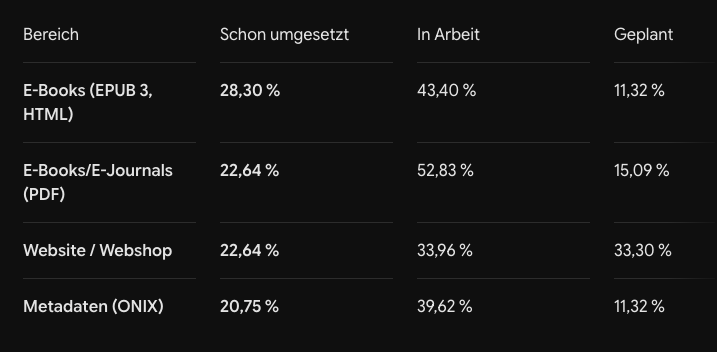
The figures reflect a well-known dilemma within the industry: the open and, in any case, more flexible EPUB format has the highest proportion of conversions already completed, at over 28 per cent. In contrast, the PDF format – although ‘in progress’ for over half of those surveyed (approx. 53 per cent) – often proves to be significantly more rigid and complex in practice when it comes to accessible formatting. There is also still a significant need for action regarding distribution channels (websites/online shops) and ONIX metadata: here, the majority are still either in the implementation or planning phase.
Significance: A sense of duty rather than enthusiasm
How important do publishers consider accessibility to be for their own future? On this point, the survey paints a pragmatic, almost sobering picture.
For almost half of those surveyed (49.06 per cent), the issue is indeed a high priority – though primarily for reasons of legal compliance. Accessibility is seen here as a necessary obligation in order to avoid legal consequences.
A strategic advantage? Only around 24.53 per cent see accessibility as a genuine competitive advantage combined with a social responsibility.
Neutrality: Just over 26.42 per cent view the issue as neutral or of little importance.
The fact that enthusiasm remains subdued in some parts of the industry is also due to the lack of impetus from the market. The anonymous comments in the survey make it clear that many publishers have simply not received any customer enquiries on this subject to date. Consequently, there is currently little confidence that accessibility will enable them to tap into entirely new, affluent target groups in the short term.
Digital maturity by type of publisher
The economic significance of digital business varies greatly depending on the type of publisher, which also explains the pressure to implement accessibility:
Academic publishers: Have the highest level of digitalisation. For 67 per cent of respondents, digital revenue accounts for 31–60 per cent of total revenue, whilst a further 17 per cent report a figure of over 61 per cent.
Specialist publishers: are demonstrating a solid digital foundation. 42 per cent generate a digital share of 11–30 per cent, whilst 35 per cent even achieve a share of 31–60 per cent.
General-interest publishers: They bring up the rear in terms of digital revenue. For almost half (47 per cent) of them, the digital share is less than 10 per cent.
Educational publishers: The picture is highly fragmented. Whilst 27 per cent account for less than 10 per cent, a further 27 per cent already account for 31–60 per cent – a striking number (36 per cent) are unable or unwilling to provide any information on this (“I don’t know”).
The great technological divide: PDF vs. EPUB by publisher type
The most significant difference lies in the standards used. In this respect, the market is completely divided along product lines:
General-interest publishers are focusing on EPUB and the web: for them, the PDF format plays a minor role (only 14 per cent use PDF/UA). Instead, the EPUB Accessibility Standard and the WCAG (for the web and online shops) each account for 43 per cent of the market.
Academic and educational publishers rely heavily on PDFs: academic papers and school textbooks are largely based on fixed layouts. Consequently, PDF/UA dominates here as the primary standard (academic: 46 per cent, educational: 45 per cent). EPUBs play a significantly smaller role in educational publishing (18 per cent) than in the general market.
Different obstacles to implementation (by type of publisher)
Although the shortage of resources is evident across the board, different types of publishers prioritise their biggest problems in different ways:
General-interest publishers are suffering from an acute staff shortage: for a staggering 40 per cent, a lack of staff is by far the biggest obstacle – financial resources lag far behind (27 per cent).
Educational publishers are grappling with legal uncertainty: alongside staff shortages (23 per cent), unclear legal requirements and interpretations (23 per cent) are cited as the main obstacle. This suggests that the legal requirements for complex, interactive educational materials are more difficult to define.
Specialist and academic publishers are held back by budget constraints: for both types, high costs and a lack of funding top the list of obstacles (specialist publishers: 26 per cent; academic publishers: 31 per cent).
Distribution channels and reliance on third parties
The structure of the sales organisation has a significant influence on the extent to which publishers can operate independently – particularly when it comes to providing accessible online shops or metadata:
The dependence of trade publishers: 70 per cent of the trade publishers surveyed distribute their e-books via external retailers (such as Amazon, Tolino, etc.). Only 25 per cent use their own online shop. They are extremely reliant on these sales platforms supporting accessibility.
The autonomy of specialist and educational publishers: In this sector, publishers have much greater control over their own distribution. Their own online shop / direct sales is the leading channel (educational publishers: 53 per cent, specialist publishers: 51 per cent). For these publishers, ensuring their own platforms are accessible is a significantly higher priority.
Conclusion
Whilst general-interest publishers primarily face a structural staffing issue when dealing with EPUBs for external distribution, specialist, educational and academic publishers are grappling with budgetary issues and legal uncertainties when converting complex PDF documents for their own direct sales.