How to introduce AI agents
A roadmap by Elke Katharina Meyer, Frank Nesemann and Thomas Achim Werner
Published: 30 July 2026 | Photo / Video: AI-generated, Magnific
When companies use AI to automate processes within their organisation, the working conditions and the nature of their employees’ work also change. That is why such projects also require professional leadership. Below is a possible roadmap for such change projects.
“How can we use artificial intelligence (AI) to boost our efficiency and maintain our competitiveness?” This is a question many companies are currently asking themselves, and quite a few are already using so-called AI agents, for example in the areas of
Customer service (for example, autonomous voice and text agents handle enquiries, book appointments and manage returns),
Knowledge management (for example, agents organise internal data and produce documentation) and
Marketing and sales (for example, agents handle content creation and identifying potential customers).
Objective: To improve performance using AI agents
AI agents are software programmes that not only answer questions like traditional chatbots, but also plan and carry out tasks independently in order to achieve specified objectives. In doing so, they make decisions and take action largely autonomously, i.e. without further human instructions. They are able to do this by independently
use tools such as databases, calendars, email clients, etc., and
break down complex tasks into smaller steps and adapt their actions or reactions to the specific requirements.
Furthermore, AI agents possess a kind of memory. This enables them to learn from previous (inter)actions, which is why their performance improves over time.
Companies hope that the use of such AI agents will boost their efficiency and performance – whether in reality or from the customer’s perspective. However, their (potential) deployment usually triggers uncertainty and often resistance amongst staff, as they find themselves asking questions such as:
Will my skills and expertise still be needed in the company in the future?
Will the use of AI have a negative impact on my professional role (for example, a loss of status or influence)?
Do I need to acquire new skills in order to work in this changed environment?
The use of AI requires professional planning
Any potential use of AI must therefore be planned with the necessary professionalism, not least to ensure that those affected do not
perceive as an existential threat and
Their trust in and sense of identification with their employer is declining.
That is why we, the Positivity Guides, have developed a sample roadmap illustrating how AI automation can be systematically implemented and evaluated in profit and non-profit organisations – drawing, admittedly, on John P. Kotter as a possible change architecture.
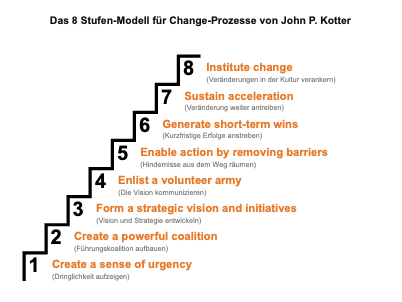
We combined this change model with the PERMA-Lead tool – which is based on the Positive Leadership model – as our management framework, in order to systematically strengthen employees’ psychological safety and engagement, as well as their skills development. The overarching aim was to draw up a roadmap in which each phase of Kotter’s stage model is accompanied by specific leadership measures, communication formats, deliverables, as well as metrics and potential risk mitigation measures, thereby creating a blueprint for the successful introduction of AI agents.
Projects to introduce AI rarely fail for ‘technical’ reasons
This is due, amongst other things, to the following: a shortcoming of many projects aimed at introducing and utilising AI is that they are set up purely as technology or process projects. Insufficient consideration has been given to the fact that this change also alters the structure of collaboration, work processes, and the roles and job responsibilities of staff.
In practice, such projects are less likely to achieve the desired success for technical reasons than because of the following factors:
Loss of trust and control: Due to a lack of integration and information, staff perceive the automation process as a ‘black box’ and a threat to their professional identity.
Skills gaps: New ways of working and tasks (such as exception management and ensuring data quality) have not been sufficiently learnt, leading to an increase in the frequency of errors and, consequently, frustration.
Change fatigue: Following an initial surge of enthusiasm in the pilot project, momentum wanes – for example, due to a failure to scale up, unclear lines of responsibility, or a lack of embedding.
A successful AI transformation therefore requires two parallel management systems:
Process control: including lead time, error rate, queries, ticket volume, exception rates, and quality and compliance parameters.
People-centred management: including understanding, psychological safety, a sense of competence, participation/engagement, purpose and perceived fairness.
The PERMA-Lead tool is recommended for ‘people management’ because it regards the two factors of ‘employee wellbeing’ and ‘performance’ as mutually reinforcing. In the context of managing change processes, this means that positive leadership is not a ‘soft add-on’ but a central element of risk management, designed to prevent resistance, a loss of skills and motivation, unwanted staff turnover, etc.
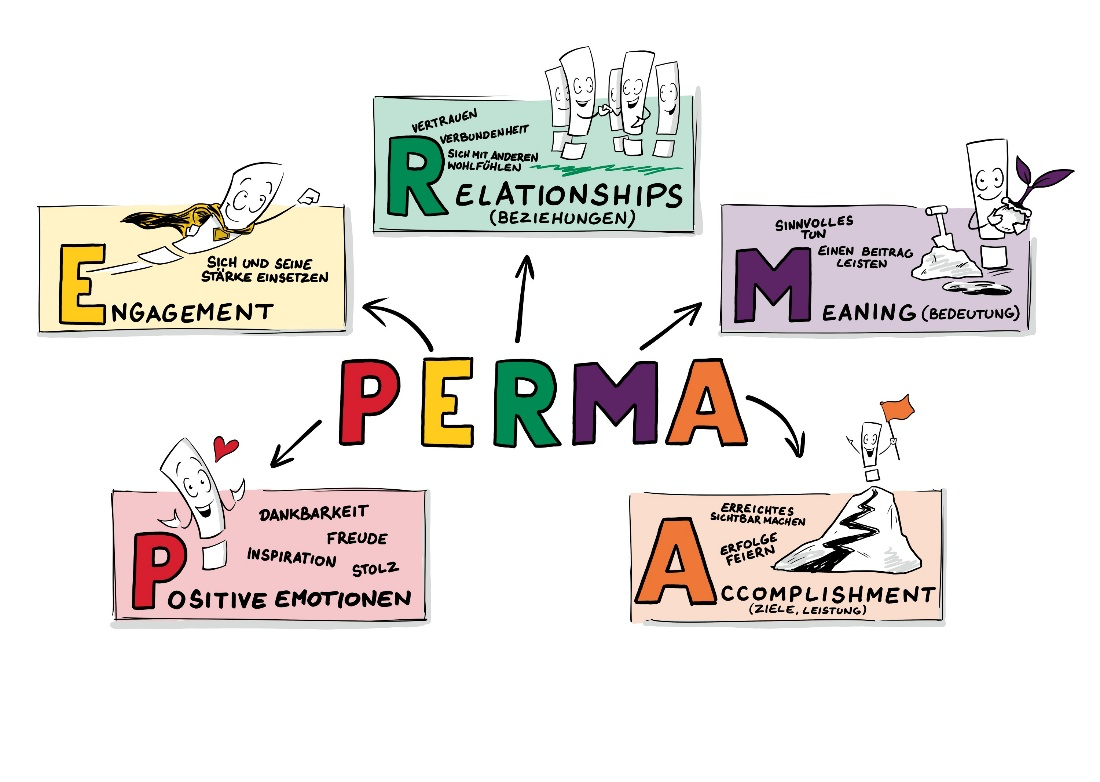
Caption: Dimensions of the PERMA model according to Martin Seligman
Dimensions of the PERMA model according to Martin Seligman
To successfully manage projects aimed at automating (sub-)processes using AI, a clear evaluation system with defined key performance indicators (KPIs) is also required. The following approach has proven effective:
Process KPIs (examples)
Processing time per case / processing costs
Error rate / Correction loops / Rework
Automated vs. manual vs. exception
Number of enquiries/escalations per 100 cases
Quality checks (e.g. audit rate, compliance with defined audit rules)
People-related KPIs (examples)
Pulse Check (monthly or fortnightly): understanding, sense of security, confidence
Competence self-assessment (before/after training sprints)
Participation (taking part in Q&A sessions, contributing to co-design, acting as a champion)
Perception of fairness/transparency (“What is fact, assumption or open to interpretation?”)
Change fatigue (energy, overload)
It is important to note that interpreting KPIs usually requires a certain level of change management expertise as well as an understanding of the overall system. This is because, in a project, for example, process KPIs may improve in the short term, whilst people-related KPIs may deteriorate. This is often a warning sign of future setbacks such as quality issues, resistance or the loss of key staff. Similarly, in a pilot project, people-related KPIs may be positive even though process KPIs have not yet shown any improvement. However, this initial euphoria usually fades quickly if the collective efforts do not bear fruit in a timely manner.
A roadmap for AI-driven automation projects
Kotter’s 8-step model provides, so to speak, the framework for guiding an organisation through the change process of ‘introducing and establishing AI automation’ (see Figure 1). However, its practical effectiveness stems from the fact that each stage is underpinned by leadership actions, communication formats, deliverables and metrics, which in turn are supported by PERMA-Lead principles (see Figure 2).
In what follows, the eight steps towards the objective are deliberately presented in such a neutral manner that this basic concept can be adapted to industrial and service companies as well as public administrations.
Step 1: Create a sense of urgency – without resorting to a narrative of threat
Objective: To establish a basis for automation without exploiting people’s fears.
Operational Management Practice
A three-part kick-off: 1. Facts & Why, 2. Emotions & Concerns, and 3. 30-day action plan
Job Impact Map (tasks rather than people): “What will be automated? What will remain the preserve of humans? What new roles will emerge?”
‘Knowledge/Open’ list: set it up, maintain it consistently, make it visible, and keep it up to date
Positive Leadership / PERMA-Lead
Meaning: Translate “Why now?” into everyday language (customer benefits, quality, security, scalability)
Relationships: Transparency reduces the spread of rumours
Positive emotion: Acknowledging concerns without over-dramatising them; strengthening one’s ability to take action.
Measurement/Risks
Pulse Check (understanding/sense of security).
Risk: Rumours and job insecurity → Countermeasure: Clearly distinguish between facts, assumptions and unresolved issues + regular Q&A sessions.
Step 2: Building a leadership coalition – fostering trust through visible accountability
Objective: To embed change not as an ‘IT project’, but as an organisational transformation.
Operational Management Practice
Cross-functional core team (Process, IT/Automation, Service, HR where applicable, Quality/Compliance).
Define roles and decision-making processes (sponsor, change lead, communications, training, process owner, Q&A).
Team Charter: psychological safety (‘Questions and mistakes are learning opportunities’).
Positive Leadership / PERMA-Lead
- Relationships: Credibility is built through closeness, approachability and fairness.
- Engagement: Participation increases when ‘Who decides what?’ is transparent.
Measurement / Risks
- Participation rate in feedback sessions; number and quality of responses
- Risk: ‘ivory tower’ → Countermeasure: Input from the teams concerned + feedback loops
Step 3: Vision & Initiatives – Making ‘Human + Agent’ easy to understand
Objective: To create a vision that is specific enough to guide decisions and behaviour.
Operational Management Practice
· Vision across the following three levels:
1. Benefits (ease of use, quality, safety)
2. Rules (human-in-the-loop, approvals, escalation procedures)
3. Roles/Skills (Q&A, exception management, process ownership, data quality)
· 3 to 5 initiatives (pilot schemes, training sessions, support/Q&A, Change-Bot/FAQ).
Positive Leadership / PERMA-Lead
· Meaning: Vision = purpose + path + boundaries (not just ‘why’)
· Engagement: initiatives as opportunities for active participation
· Accomplishment: Start measuring the current situation early on to enable genuine before-and-after comparisons
Measurement / Risks
· Clarity of the vision (short survey), number of use cases understood
· Risk: The vision comes across as marketing → Countermeasure: swift, visible steps towards implementation.
Step 4: Mobilisation – turning employees into active contributors
Objective: To generate momentum for change, foster a sense of ownership and establish learning networks.
Operational Management Practice
- ‘Automation Champions’ (voluntary, with a time allocation).
- Co-design sessions: Concerns/obstacles → Ideas → Pilot backlog
- Visible feedback loops: ‘You said…; we’ve changed…’.
Positive Leadership / PERMA-Lead
- Engagement: Self-efficacy arises from genuine participation.
- Relationships: Peer support helps people feel more at ease.
- Positive emotion: brief, positive reflective questions as an antidote to the ‘problem tunnel’.
Measurement / Risks
- Champions’ activities, number of ideas implemented.
- Risk: Overwork/cynicism → Countermeasure: Reducing workload, clarifying priorities, mini-wins.
Step 5: Removing barriers – competence as a means of combating fear
Objective: To enable people to take action: rules, skills, support, time.
Operational Management Practice
- Training sprint (practical): dealing with agents, exceptional cases, Q&A, data quality.
- Operating procedures: human-in-the-loop, escalation procedures, treating errors as learning opportunities (clearly defined).
- Support model: consultation hours, peer coaches, checklists, standard workflows.
- Change-Bot as a coach: FAQs, ‘where can I get help?’, routing enquiries to people.
Positive Leadership / PERMA-Lead
- Accomplishment: Building competence creates stability because people experience progress.
- Relationships: Support must be accessible and respectful.
- Commitment: Learning requires dedicated time (not ‘on the side’).
Measurement / Risks
- Training frequency, self-assessment of skills, overcoming barriers.
- Risk: ‘No time for learning alongside day-to-day work’ → Countermeasure: Set aside specific time for learning; prioritise less.
Step 6: Short-term successes – prove it rather than just claim it
Objective: To build trust and acceptance through transparent evidence.
Operational Management Practice
- 2 to 3 pilot processes with clear KPIs (throughput time, error rate, queries, bottlenecks).
- Winning rituals: showcase results, recognise the team, highlight lessons learnt.
- Change-Bot live: Q&A + feedback channel.
Positive Leadership / PERMA-Lead
- Positive emotion: Relief is more powerful than motivational talk.
- Achievement: visible effectiveness boosts adoption.
Measurement / Risks
- Process KPIs + Pulse Check.
- Risk: ‘embellished profits’ → Countermeasure: Ensure transparency in raw data logic and methodology.
Step 7: Acceleration – scaling up without change fatigue
Objective: To turn pilot schemes into standards and maintain a high level of enthusiasm for learning.
Operational Management Practice
- Rollout roadmap (sequence, rationale, ownership for each process).
- Champions → Peer coaches.
- Operational concept: support, Q&A, updates, responsibilities.
Positive Leadership / PERMA-Lead
- Commitment: Taking ownership rather than micromanaging.
- Relationships: Learning through networks.
- Meaning: Make the benefit of each step clear.
Measurement / Risks
- Number of processes migrated, support tickets, acceptance.
- Risk: Resistance to change → Countermeasure: Pacing, recognition, breaks, clear priorities.
Step 8: Consolidation – ‘This is how we do things here’
Objective: AI-driven working practices will become the norm.
Operational Management Practice
- Role profiles, onboarding, standards, Q&A procedures, learning procedures.
- Cultural anchor: Objections are still permitted, but are dealt with in a structured manner.
- Change-Bot as the ‘single source of help’.
Positive Leadership / PERMA-Lead
- Relationships: psychological safety as the norm, not just a campaign.
- Achievements: consistent quality, fewer tickets, growing expertise.
- Meaning: ‘What remains human?’ – Responsibility, judgement, relationships.
Measurement / Risks
- Process quality remains stable, competence is increasing, and the relapse rate is falling.
- Risk: Slipping back into old habits → Countermeasure: designated owners, reviews, leadership setting an example by adhering to standards.
“Keep it – as far as possible – simple and smart”
Another key factor for success is the availability of user-friendly tools, particularly for those responsible for the project – including the managers involved – to enable them to carry out their tasks within the project. Three such tools, which are applicable across various sectors, are briefly mentioned here.
1. Facts/Assumptions/Open Board (transparency of change): reduces rumours, increases fairness.
2. Job Impact Map: provides reassurance by clarifying tasks, roles and new skills.
3. AWB communication standard (attentive – supportive – engaging): de-escalates situations, increases psychological safety, and fosters a positive attitude towards learning.
Three tools that are relatively easy to use are deliberately presented here, because: in many organisations, the desired or necessary changes are already highly complex, so the management framework should not be made unnecessarily complicated.
Conclusion: AI automation requires leadership and process excellence
AI agents can relieve company staff and their departments of routine tasks and improve the quality of their work. However, the extent to which their introduction yields genuine benefits for companies depends, amongst other things, on how processes and people are managed throughout the course of the project. The guiding principles during this phase of transformation or change should be:
Clarity rather than threat,
Building skills rather than overwhelming people,
Participation rather than a top-down approach and
Transparency rather than rumours.
Kotter’s 8-step model provides the necessary structure for this, whilst the PERMA-Lead framework offers a leadership approach that turns people into motivated allies, even in the face of far-reaching change. Together, they form a change or transformation approach that does not merely ‘introduce AI systems and tools’, but empowers organisations to deal with change professionally – one of the key success factors for businesses in an environment characterised by rapid and fundamental change.

Elke Katharina Meyer, Frank Nesemann and Thomas Achim Werner together form the management team at the management consultancy Positivity Guides, Berlin/Braunschweig (www.positivity-guides.de). Together, they have written the book *Positive Leadership! Empowering Teams and Organisations with Positive Leadership*, published by BusinessVillage.